
I'll be honest: I dismissed Shilajit for years. The name alone, exotic, unfamiliar, wrapped in Ayurvedic mystique, triggered every skeptical reflex I have as a researcher. "Ancient remedy" is not a phrase that makes a molecular biologist sit up and pay attention. It's the kind of phrase that usually precedes a marketing pitch dressed up as science.
So I ignored it. I filed it in the same mental drawer as ashwagandha gummies and tribulus terrestris, things people on Reddit swear by and that never hold up when you actually read the methodology.
Then, during a late-night literature review in 2023, I stumbled on a study that made me stop scrolling. Not because of the headline. Because of the study design. Randomized. Double-blind. Placebo-controlled. Adequate sample size. Published in a legitimate peer-reviewed journal. And the results were specific enough to be either clearly true or clearly fabricated.
I spent the next several weeks pulling apart the data. Here's what I found.
What Shilajit Actually Is
Before getting to the clinical data, it helps to understand what we're talking about at a molecular level. Shilajit is a geological substance, a dark, resinous material found primarily in the Himalayan, Altai, and Caucasus mountain ranges. It forms over centuries from the slow decomposition of plant matter compressed between layers of rock.

The composition is complex. The primary bioactive components include fulvic acid (60-80% of the purified form), dibenzo-alpha-pyrones (DBPs), DBP-chromoproteins, and over 85 minerals in ionic form. It's not a plant extract. It's not a mineral supplement. It's something genuinely unique in the natural compounds space, a geological-biological hybrid that doesn't fit neatly into any standard supplement category.
What caught my attention from a biochemistry standpoint was the fulvic acid fraction. Fulvic acid is a potent electron carrier and mitochondrial cofactor. If you understand that the enzymatic reactions inside Leydig cells, the cells responsible for testosterone synthesis, are energy-dependent processes that rely on mitochondrial function, the potential mechanism of action starts to make theoretical sense. But theory isn't data. So let's look at the data.
The Pandit et al. 2016 Study
The study that changed my mind was published in Andrologia in 2016 by Pandit, Biswas, and Debnath. Here are the details that matter.
Design: Randomized, double-blind, placebo-controlled clinical trial. This is the gold standard for evaluating a compound's efficacy. Neither the participants nor the researchers knew who received Shilajit and who received placebo until the data was unblinded.
Participants: 96 healthy male volunteers, aged 45-55. Not hypogonadal patients. Not men on medications. Healthy men experiencing typical age-related hormonal changes. This is important because it tells us whether the compound works in the population most men belong to, not just in clinically diagnosed patients.
Dose: 250mg of purified Shilajit, twice daily (500mg total daily dose).
Duration: 90 consecutive days.
Primary endpoints: Total testosterone, free testosterone, DHEAS, LH, FSH, and gonadotropin levels.
The Results
After 90 days, the Shilajit group showed the following changes compared to placebo:
DHEAS, dehydroepiandrosterone sulfate, a key precursor hormone in the androgen synthesis pathway, also increased significantly in the Shilajit group.
These are meaningful effect sizes. A 20 to 40% increase in total testosterone, the range observed across the Pandit trial and the real-world cases that follow it, is not noise. For a man sitting at 400 ng/dL, that's the difference between 400 and somewhere between 480 and 560, enough to cross from "low-normal" into a range where many men report perceptible improvements in energy, body composition, and drive.
Why Real-World Results Often Exceed the 20% Average
Before I continue, I want to address something I've learned from my own data and from the readers who've written to me over the years. The 20.45% figure from Pandit is the clinical trial average. It is not the ceiling. It is arguably closer to the floor.
Four reasons why individual results in practice often substantially exceed the trial average:
1. Clinical trials include non-responders. Any RCT average is pulled down by a subset of participants who respond minimally or not at all, for reasons ranging from genetics to gut absorption to unmeasured confounders. A 20% mean is the product of some men seeing no change and others seeing much larger increases. The average is an average; your biology is a specific case.
2. 90 days is a minimum window, not an endpoint. The Pandit trial ran for the shortest duration that could reliably detect an effect. Testosterone production is a slow-moving system, Leydig cell health, mitochondrial efficiency, and precursor pool recovery are not processes that fully complete in three months. Men who continue for 4 to 6 months, in my experience, tend to see continued improvement beyond the 90-day snapshot.
3. The trial participants weren't optimizing context. Pandit's subjects were healthy middle-aged men going about their normal lives. They weren't simultaneously fixing sleep, body composition, stress, or endocrine disruptor exposure. In a man who addresses those upstream factors while supplementing Shilajit, the gains compound. The RCT isolates one variable. Real life stacks them.
4. My own data and what I hear from readers. My baseline was 187 ng/dL. Three months after starting a multi-target protocol that included properly standardized Shilajit alongside eight other compounds chosen for their combined effect across the full HPG axis, I was at 566, a roughly 200% increase, not 20%. That is not a study result, it is a single data point. But I'm not alone. Readers who've written to me include a man who went from 289 to 534, another who reached 618 after coming off TRT, and many who report qualitative changes of the same order of magnitude. I wrote about several of these cases, and the full protocol I built, in my personal account.
The right mental model: treat the Pandit 20% as the conservative floor for what Shilajit alone can deliver in a tightly controlled 90-day window. Actual individual responses, particularly when Shilajit is taken as part of a multi-target protocol that addresses the other links in the HPG chain (cortisol regulation, brain-level signaling, free testosterone availability, absorption), can land well above that, at 100-200% increases over baseline in the cases I've documented. The Pandit study isolated one variable. A real-world protocol stacks several at once, which is why the numbers diverge.
The Key Finding: LH and FSH Were Maintained
This is the detail that elevates this study from interesting to genuinely significant. In the Shilajit group, LH and FSH levels were maintained, they were not suppressed.
Why does this matter? Because of the HPG axis. If a compound raises testosterone by delivering it exogenously (like TRT), the body's feedback loop detects the elevated T and shuts down GnRH, which suppresses LH and FSH. That's how you get testicular atrophy and dependency.
The fact that Shilajit raised testosterone while LH and FSH remained stable means the HPG axis was not suppressed. The body was producing more of its own testosterone through its own machinery. The feedback loop was intact. The testes were still receiving the signal and still doing the work, they were just doing it more effectively.
This is the biomarker pattern I described in my article on the HPG axis as the hallmark of a compound that works with the body rather than replacing its function. It's exceptionally rare in the testosterone supplement space.
Proposed Mechanism of Action
Based on the study data and the known biochemistry of Shilajit's components, the proposed mechanism operates on several levels:
Mitochondrial support in Leydig cells. Testosterone synthesis is an energy-intensive process that takes place inside the mitochondria of Leydig cells. Fulvic acid acts as an electron shuttle, enhancing mitochondrial electron transport chain efficiency. Better mitochondrial function in Leydig cells means more efficient conversion of cholesterol to testosterone.
DHEAS precursor elevation. The significant increase in DHEAS suggests that Shilajit is supporting the upstream precursor pathways, not just the final conversion step. DHEAS is a reservoir hormone that feeds into multiple androgen synthesis routes.
Enzymatic activation. The key enzymes in testosterone synthesis, particularly 3-beta-hydroxysteroid dehydrogenase (3-beta-HSD) and 17-beta-hydroxysteroid dehydrogenase (17-beta-HSD), require cofactors and adequate cellular energy to function optimally. The trace minerals and fulvic acid in Shilajit appear to support these enzymatic pathways.
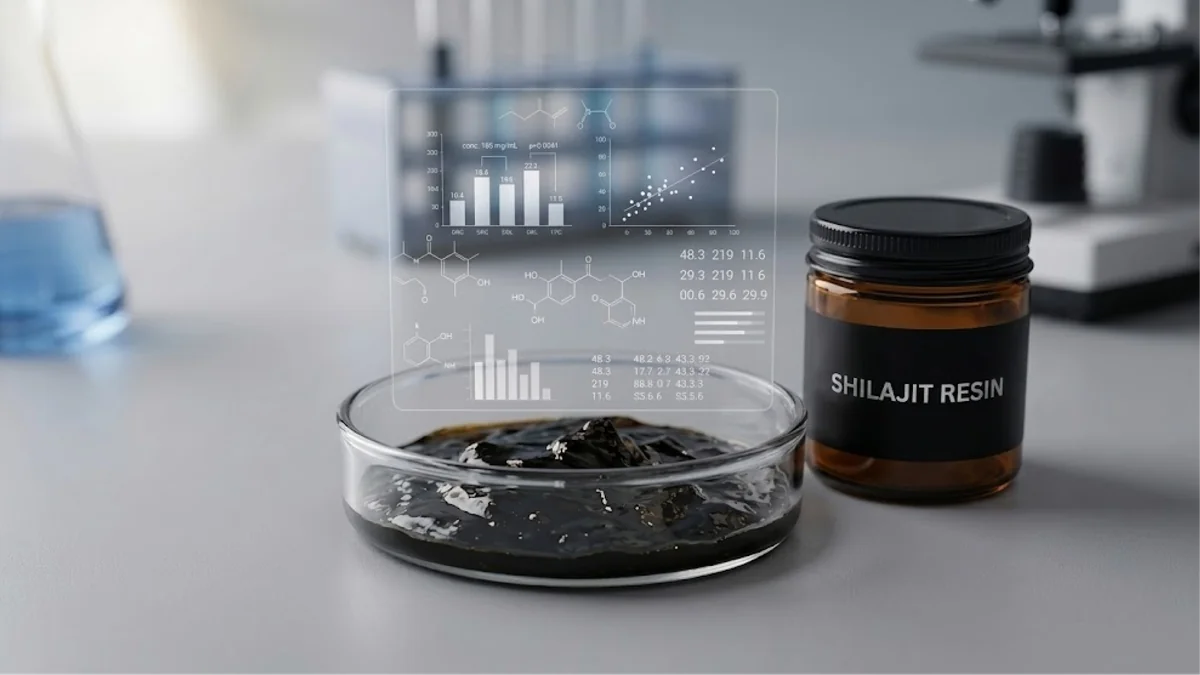
This multi-level mechanism is consistent with the observed biomarker pattern. Shilajit isn't forcing testosterone production through a single pharmacological lever, it's providing the raw materials, energy substrates, and cofactors that the existing machinery needs to function at a higher level.
What the Data Doesn't Show
Intellectual honesty requires acknowledging the limitations. I take them seriously, and you should too.
Long-term data is limited. The Pandit study ran for 90 days. We don't have robust data on what happens at 6 months, 12 months, or 5 years of continuous use. The safety profile over 90 days was clean, no significant adverse events, no liver or kidney function abnormalities. But 90 days is not forever, and I won't pretend it is.
Dose-response curves aren't fully mapped. We know that 500mg/day produced these results. We don't have detailed data on whether 250mg produces half the effect, or whether 1000mg produces more. The dose-response relationship matters and remains incompletely characterized.
Population specificity. The study was conducted in men aged 45-55. While the mechanisms of action should theoretically apply to younger men as well, we don't have identical trial data in men aged 25-35. Extrapolation is reasonable but not the same as direct evidence.
Replication. While other studies on Shilajit exist and generally support these findings, the Pandit study is the strongest single piece of evidence. More independent replication, particularly from research groups without industry ties, would strengthen the case considerably.
My Assessment
Applying the evidence framework I use for all supplement evaluation: Shilajit is one of very few natural compounds I've encountered that meets my minimum criteria for serious consideration. It has a randomized, double-blind, placebo-controlled trial in healthy human males with adequate sample size, clinically meaningful effect sizes, and, critically, a biomarker pattern that indicates it works with the HPG axis rather than against it.
That doesn't make it a miracle substance. It makes it a compound with actual clinical evidence behind it, which in the testosterone supplement space, puts it in extremely rare company.
It also doesn't make it a complete solution on its own. Shilajit acts powerfully at one level of the testosterone production chain (the testes, specifically Leydig cell mitochondrial function and enzymatic conversion). It does not address the brain-level signaling, the stress axis, free testosterone availability, or absorption. Those are separate pressure points that need their own evidence-backed compounds. Shilajit is one piece of a complete protocol, the strongest single piece I've found at its specific level of the chain, but a piece nonetheless.
A Note on Quality
One final point that I cannot emphasize enough: most commercial Shilajit products are not what the clinical studies used. Raw Shilajit from the mountains contains heavy metals, free radicals, and mycotoxins. The studies used purified, standardized extracts, specifically processed to concentrate the bioactive components while removing contaminants.
If you buy cheap Shilajit resin from an unverified source, you're not getting what was studied. You're getting an uncharacterized geological substance with unknown contaminant levels. Purification and standardization matter enormously, arguably more for Shilajit than for any other natural compound, precisely because of its geological origin. This is one area where the gap between "the ingredient" and "the product" can be enormous.
For context on how I evaluate all supplement evidence, see my article on study evaluation frameworks. For the hormonal science behind why the LH/FSH finding matters, see my HPG axis deep dive. And for my personal experience tracking the effects over time, see what I learned from 3 years of monthly blood work.